Who's the Best for Cloud-Based Medical Imaging Solutions: UltraLinq vs Medicai
Your team needs to pick between Medicai and UltraLinq before the next contract renewal lands.
This article shows exactly how each platform handles cloud PACS storage limits, zero-footprint viewers, and AI workflow approvals, then states a clear winner for your use case at the end.
Quick Verdict: Medicai vs UltraLinq for Cloud-Based Medical Imaging
Medicai offers 1M+ studies processed yearly with HIPAA and GDPR compliance plus FDA/CEE cleared viewer, positioning it as the scalable choice for multi-site healthcare providers.
The core differences appear in how each platform handles access and scale. Medicai's zero-footprint viewer lets clinicians open studies in any browser without downloads. Simultaneously, 50M+ yearly API transactions and 300k+ visualizations show the system supports high-volume image sharing and collaborative workflows.
UltraLinq relies on traditional architecture that typically requires installed components and more local resources. This setup can limit flexibility when teams need fast deployment across different locations or devices.
The single deciding factor for most radiology teams is whether they need immediate browser-based access without installations. Medicai's zero-footprint viewer combined with proven transaction volumes makes it the practical choice for modern diagnostic imaging environments.
At a glance: how Medicai compares to UltraLinq on the features that matter most.
| Feature | Medicai | UltraLinq |
|---|---|---|
| Cloud-Based Medical Imaging Solutions | ✓ | ✓ |
What Is Medicai?
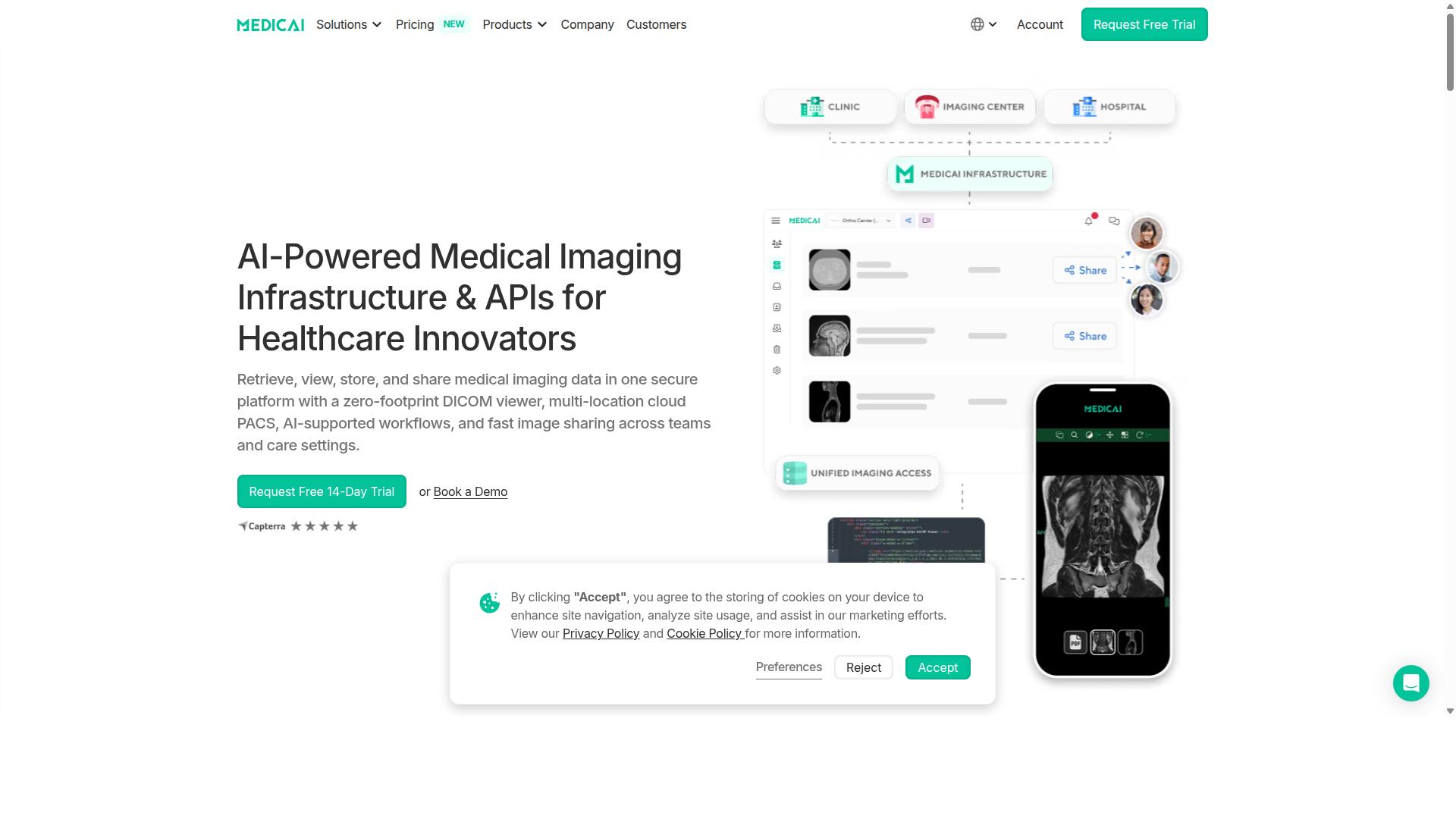
Medicai is a cloud-based medical imaging platform that retrieves, stores, and shares DICOM studies through one secure, zero-footprint environment.
The platform operates through four product pillars. CONNECT & RETRIEVE uses Medical Imaging Uploader and DICOM Gateway to bring studies into the system from various sources.
STORE & MANAGE includes Cloud PACS, Medical Image Exchange, Patient Case Management, Vendor Neutral Archive, and Backup and Disaster Recovery functions that maintain image integrity across distributed locations.
ACCESS & VIEW provides Structured Reporting for Radiology, Doctor Imaging Portal, Patient Imaging Portal, DICOM Viewer, Medicai Imaging API, and Mobile Imaging App for clinical review and collaboration.
AI & WORKFLOW INTEGRATION contains Radiology AI Co-Pilot and AI-Powered Diagnostics that support existing radiology workflows without requiring separate systems.
The platform currently archives 1.7M+ studies and operates globally for organizations that need scalable medical imaging infrastructure.
What Is UltraLinq?
UltraLinq is a cloud PACS solution used by cardiology and radiology departments to upload, store, and share ultrasound and other imaging studies.
The platform supports study upload through various modalities and provides web access for remote viewing without additional software installations. Users access studies through standard browsers on different devices.
Basic reporting features allow clinicians to document findings and generate standard reports within the system. The interface provides tools for measurement, annotation, and basic image manipulation.
Departments use UltraLinq for image archiving needs in clinical settings where traditional on-premise systems may not meet current workflow requirements.
Features Compared
Three capability areas separate the two platforms: storage scalability, real-time collaboration, and AI/security layers.
Each platform approaches these areas differently. Medicai provides specific storage tiers with defined capacity thresholds and compliance certifications. UltraLinq approaches the same capabilities through more generalized cloud infrastructure.
The differences become clear when examining storage increments, viewer capabilities, and regulatory clearances side by side.
Cloud PACS Storage and Scalability
Medicai's Starter tier starts at 500 GB and scales to 2 TB in the Standard tier, with unlimited user accounts and optional disaster-recovery add-ons.
Enterprise customers receive custom storage allocations based on volume needs. The monthly billing model includes Starter at $249 per month and Standard at $749 per month. Annual billing offers 15 percent savings with Starter at $209 monthly and Standard at $639 monthly.
UltraLinq takes a general scalability approach that allows storage expansion through standard cloud mechanisms. Specific capacity limits or tier structures remain undefined in public documentation.
Both platforms support unlimited user accounts in their base offerings. The primary distinction lies in transparent pricing models versus flexible but less defined scaling options.
Zero-Footprint DICOM Viewer and Collaboration
Medicai's viewer requires no local software install; users annotate, share, and launch 3D reconstructions instantly from any browser.
The platform processed 300k+ visualizations of DICOM studies in the last year. FHIR and HL7-ready APIs enable direct integration with existing hospital systems. The vendor neutral archive stores 1.7M+ studies currently and handles 1M+ studies transacted or processed per year.
UltraLinq maintains web viewers that function without local installations. Performance benchmarks and specific visualization capabilities remain unspecified in available materials.
Medicai's structured reporting and doctor imaging portal support multi-site collaboration across 70 clinics and hospitals. Ten thousand active doctors use the platform for image sharing and teleradiology workflows.
AI Workflows and Security Compliance
Medicai integrates directly with third-party AI engines and records every access event in an immutable audit trail.
The platform maintains HIPAA and GDPR compliance alongside FDA and CEE cleared viewers. Fifty million yearly API transactions support AI orchestration and radiology AI co-pilot functions. OWASP security guidelines guide the development process.
UltraLinq and other cloud PACS vendors generally offer encryption and access logs. Specific certifications and detailed security frameworks remain unspecified in public materials.
Medicai's mobile imaging app and patient imaging portal extend secure access beyond clinical settings. The Microsoft Azure partnership provides additional infrastructure reliability for medical image exchange operations.
Pricing Compared
Medicai lists transparent monthly rates, $249 for 500 GB and $749 for 2 TB, while UltraLinq pricing is available only after direct inquiry.
Transparency matters when radiology teams evaluate cloud PACS platforms. Fixed monthly rates let administrators forecast expenses without lengthy sales cycles or surprise add-ons.
Medicai Starter tier includes 500 GB cloud storage and unlimited user accounts for smaller practices or early-stage growth. Standard tier expands capacity to 2 TB with one connected location, suitable for single-site imaging centers.
Enterprise customers receive custom pricing based on storage needs and multiple external locations. Per-study pricing remains available for organizations that prefer usage-based billing over fixed monthly fees.
UltraLinq does not publish pricing details online. Prospective buyers must contact sales representatives to obtain quotes, which can extend decision timelines beyond initial budget planning.
DICOM Gateway setup carries a one-time fee of $1,000 per location at Medicai. This cost covers secure integration hardware required for transmitting DICOM files to the cloud archive.
Yearly billing offers 15 percent savings for organizations committed to longer contracts. The Starter tier drops to $209 monthly and Standard tier decreases to $639 monthly when paid annually.
Neither vendor discloses implementation timelines within public materials. Requesting detailed quotes from both platforms allows direct comparison of total cost of ownership across different practice sizes.
Who Should Choose Medicai
Hospitals, imaging centers, and specialty groups that need immediate global access and AI-ready workflows gravitate toward Medicai.
The platform serves orthopedics, neurology, oncology, radiology, and cardiology departments with a single cloud PACS that stores 1.7M studies and supports unlimited accounts. Teams avoid hardware investments while maintaining HIPAA compliance across multiple locations.
Zero-footprint deployment means radiologists and specialists launch the DICOM viewer directly from any browser without local software. This approach removes installation delays and reduces IT support requests that typically slow down traditional PACS implementations.
Multi-site collaboration becomes seamless when cardiologists review cardiac studies from one location while neurologists examine brain scans from another. The system supports tumor boards and clinical trials through the same interface, eliminating the need for separate image sharing tools.
Virtual care providers and teleradiology services benefit from patient portal access that keeps referring physicians and patients informed. Role-based access controls ensure each user sees only the studies and reports relevant to their clinical responsibilities.
Research and medical education organizations use the same infrastructure for teaching files and case studies. The unlimited account model removes per-user licensing concerns that often limit platform adoption in academic settings.
Who Should Choose UltraLinq
Smaller cardiology practices or radiology groups that prefer a legacy web PACS and require minimal customization may find UltraLinq sufficient. These organizations often prioritize straightforward image viewing over advanced collaboration features. The platform serves users who need basic cloud PACS functionality without complex setup requirements.
Single-site clinics with predictable imaging volumes typically experience adequate performance from this solution. Staff members who prefer familiar interfaces find the transition easier than learning entirely new systems. UltraLinq works well when teams need standard DICOM viewer capabilities without extensive training periods.
Facilities with limited IT resources often choose this option because setup remains relatively simple. Practices that do not require multi-site collaboration or advanced image sharing tools find the basic functionality meets their needs. The system provides reliable access for routine diagnostic imaging tasks.
Organizations considering cloud-based medical imaging solutions should evaluate their growth trajectory before selecting any platform. UltraLinq may require additional consideration if future expansion demands increased scalability or enhanced interoperability features. Teams should assess whether their current workflow will remain stable over the next several years.
Final Verdict
For teams that need transparent pricing, proven scale, and AI extensibility, Medicai provides the clearer path.
Organizations handling large imaging volumes benefit from a platform that processes over one million studies each year while maintaining global uptime across Azure and AWS infrastructure. This level of operational reliability supports radiology departments that require consistent access to patient data across multiple sites and time zones.
High transaction capacity becomes critical when health systems integrate imaging workflows with existing electronic health records. Medicai handles more than fifty million API transactions annually, which demonstrates the technical foundation needed for complex interoperability requirements in modern healthcare environments.
UltraLinq users seeking alternatives often cite concerns around pricing transparency and customization flexibility. Medicai addresses these needs through a subscription model that scales with organizational requirements and provides clear visibility into usage patterns and associated costs.
Healthcare providers evaluating cloud PACS solutions should consider both immediate workflow needs and future expansion plans. Medicai's architecture supports gradual implementation while maintaining HIPAA compliance standards throughout the transition process.
Teams interested in testing these capabilities can request a fourteen-day trial by contacting [email protected] or calling +1 (832) 220 1035 in the United States or +40 316 305 875 in Romania.
Recommended Resources: